

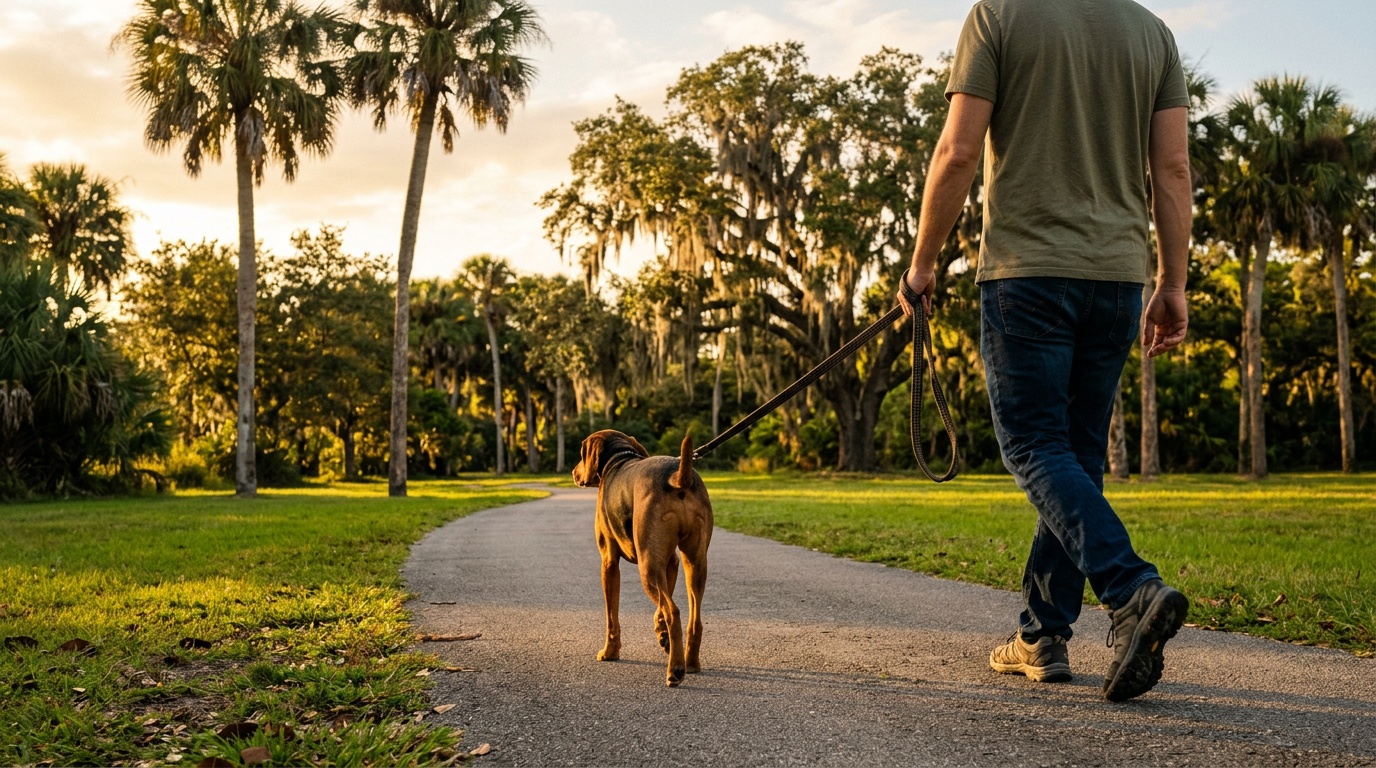
Here is the thing almost nobody tells you: there is no single Florida leash law. The state does not have one statute that says your dog must be on a leash. What Florida has instead is a patchwork of county and city ordinances that do the leashing, sitting on top of state statutes that handle what happens when things go wrong.
Understanding which layer does what is the difference between confidently walking your dog and quietly hoping you are not breaking a rule.
- 🏛️ State law (Chapter 767): owner liability, dog bites, dangerous dog classification.
- 🏙️ County and city ordinances: the actual leash requirement, where it applies, and the fine.
Why There Is No Statewide Florida Leash Law
Florida leaves animal control to local government. Each of the 67 counties writes its own animal ordinance, and cities inside those counties can add their own on top. In Hillsborough County the relevant rules sit in Chapter 6 of the county code, under Animal Control.
The practical result is that leash laws in Florida are consistent in spirit and inconsistent in detail. Nearly every jurisdiction requires a dog to be leashed or otherwise under direct physical control whenever it is off the owner’s property. What varies is the maximum leash length, whether “voice control” counts anywhere, and how much the citation costs.
If you only remember one rule, make it this one: off your property, on a leash, unless you are inside a fenced area specifically designated for off-leash use. That single habit keeps you compliant essentially everywhere in the state.
What State Law Does Cover
Owner liability for damage
Section 767.01, Florida Statutes, is short and broad: owners of dogs are liable for any damage done by their dogs to a person, or to any animal in the definitions of domestic animal and livestock. It does not ask whether you were careless. If your dog did it, you own the consequence.
Dog bites
Section 767.04 makes dog owners strictly liable when their dog bites someone in a public place, or somewhere the person is lawfully entitled to be, and it applies “regardless of the former viciousness of the dog or the owners’ knowledge of such viciousness.” There is no free first bite in Florida.
If the bitten person’s own negligence contributed, the owner’s liability is reduced in proportion to that fault. That is the only general softening in the statute.
The “Bad Dog” sign
Section 767.04 contains a provision people quote constantly and understand rarely. An owner who displays an easily readable sign including the words “Bad Dog” prominently on the premises can limit their liability, with two exceptions that swallow most of the benefit:
- 👶 It gives no protection where the bitten person is a child under six years old.
- ⚖️ It gives no protection where the owner’s own negligent act or omission caused the bite.
So the sign is a narrow defense against strict liability for adult visitors, in cases where you did nothing careless. It is not a shield, and it certainly is not a substitute for a fence.
Dangerous dogs
Part II of Chapter 767 handles dangerous dog classification. Section 767.11 defines a dangerous dog, broadly, as one that has aggressively bitten or severely injured a person, has severely injured or killed a domestic animal more than once off the owner’s property, or has chased or approached someone in a menacing fashion without provocation.
Section 767.12 sets out what follows a final classification: a certificate within 14 days, renewed annually, proof of rabies vaccination, a proper enclosure, and permanent identification. A classified dangerous dog may not leave that enclosure unless it is muzzled and restrained by a substantial chain or leash under the control of a competent person.
Most owners think of the Florida leash law as being about their own dog’s safety. The liability statutes flip that around. An off-leash dog that startles a cyclist into a fall, or gets into a fight with a leashed dog, puts the off-leash owner squarely on the wrong side of section 767.01, even if nobody was bitten.
Where Dogs Can Legally Be Off-Leash
Designated, usually fenced, off-leash areas. That is the list. Florida leash laws for dogs make no general exception for a well-trained dog in a regular park, and “he’s friendly” is not a legal category.
Around Tampa Bay and central Florida, these are the kinds of places where off-leash is actually permitted:
- 🐕 Dog Park at Al Lopez Park: 1.5 fenced acres off North Himes Avenue, with separate large and small dog areas
- 🌳 Carrollwood Village Dog Park: West Village Drive, north Tampa
- 🌊 Apollo Beach Dog Park: Golf and Sea Boulevard, south Hillsborough
Everywhere else, the leash stays on. That includes trails and green space where it feels like nobody would mind. Flatwoods Park in Thonotosassa and Lake Eola Park in downtown Orlando are both excellent dog walks and both on-leash.
Our full guide to dog parks in Tampa lists sixteen fenced off-leash parks with their hours and rules, and the Parks and Outdoor Fun map covers the rest of the region.
Beaches Are Their Own Rulebook
Beach access is not governed by the leash ordinance you are used to. The default across Florida is that dogs are not allowed on public beaches at all, and the dog-friendly ones are specific designated exceptions with their own posted rules.
Even at those, the leash rules shift within a few yards: at most Tampa Bay dog beaches, dogs are off-leash on the sand and leashed in the parking lot and on the walkways. Our guide to dog-friendly beaches in Tampa Bay covers all three off-leash beaches in the region and where the boundaries fall.
Many Florida ordinances and nearly every designated dog beach cap leash length at six feet. A retractable leash extended to twenty feet fails that test even though the dog is technically leashed. If you carry one, lock it short in public areas.
Frequently Asked Questions
Is there a leash law in Florida?
Not at state level. Florida has no single statewide leash statute. Leash requirements come from county and city ordinances, and virtually all of them require a dog to be leashed or under direct physical control off the owner’s property. State law handles liability instead, through Chapter 767.
What does the “Beware of Dog” sign law in Florida actually do?
Section 767.04 refers to a prominently displayed, easily readable sign including the words “Bad Dog.” It can limit an owner’s strict liability for a bite, but not where the bitten person is a child under six, and not where the owner’s own negligence caused the bite.
Can my dog be off-leash on a trail in Florida?
Almost never. Florida dog leash laws apply on trails the same way they apply on sidewalks. Off-leash access is limited to designated areas, which in practice means fenced dog parks and a small number of designated dog beaches.
What is the fine for breaking the leash law in Florida?
It depends on your county, because the ordinance is local. Fines commonly escalate for repeat offences, and an animal control pickup adds impound and boarding costs on top. Your county animal services department publishes the current schedule.
Am I liable if my leashed dog bites someone who approached us?
Potentially yes, because section 767.04 is a strict liability rule. Your liability is reduced in proportion to the other person’s negligence if their own conduct contributed, but being leashed does not by itself remove responsibility.
Do leash laws in Florida apply to my own front yard?
Ordinances generally apply once the dog is off your property, but an unfenced front yard is where this gets uncomfortable. A dog that wanders off an unfenced yard onto a sidewalk is at large, and Chapter 767 liability follows it. If the yard is not fenced, leash the dog.
This article summarizes Florida statutes as published by the Florida Legislature, plus the general pattern of county ordinances. It is general information, not legal advice, and your county’s ordinance is the one that governs you. Check with your county animal services for the current text.