
There are exactly two routes, and the right one depends less on your budget than people expect. Working out how to get a service dog in Florida means choosing between applying to a training program, which is often free but slow, and owner-training, which is faster to start and much harder to finish.
This guide walks through both honestly, including the parts that usually get left out.
Florida requires no license, registration or certification for a service dog. There is no state list to join. What makes a dog a service dog is that it is trained to perform tasks directly related to your disability, nothing else. Our guide to Florida service dog laws covers the access rights that follow from that.
Step One: Confirm a Service Dog Is the Right Tool
A service dog performs trained tasks. Before you start, you should be able to finish this sentence concretely: “I need a dog that will ______ when ______ happens.”
Retrieve medication during a seizure. Alert to a dropping blood sugar. Guide around obstacles. Apply deep pressure to interrupt a dissociative episode. Brace so I can stand from a chair.
If the honest answer is closer to “I feel calmer when my dog is nearby,” that is real and valuable, but it describes an emotional support animal rather than a service dog. The two have very different rights in Florida, and our guide to Florida emotional support animal laws explains that path.
Path One: Apply to a Service Dog Program
Established nonprofits breed, raise and train dogs for a specific disability, then match them to a handler and train the two of you together. You receive a dog that is already fully task-trained and public-access ready.
Florida has a significant advantage here: Southeastern Guide Dogs, based in Palmetto just south of Tampa, is one of the larger programs in the country and provides its dogs at no cost to the recipient. Nationally, organizations like Canine Companions operate on a similar model.
What to expect
- 💰 Cost. Many programs are free to the recipient. Producing a service dog costs the organization tens of thousands of dollars, funded by donations.
- ⏳ Wait. Commonly one to three years from application to placement. This is the real price.
- 📋 Application. Medical documentation, references, interviews, and often a home visit.
- 🎓 Team training. Most programs require you to attend an in-person course, sometimes residential for two weeks or more.
- 🎯 Specialization. Programs usually focus on particular disabilities, so match your need to the organization rather than applying everywhere.
Waitlists are long and independent of each other. If you are eligible for several programs, apply to all of them and keep the applications current. The worst outcome is discovering after two years that you were never on the list you thought you were.
Path Two: Owner-Training
Florida law permits you to train your own service dog. No program, no certification, no state approval. That freedom is genuine, and it is also why owner-training fails more often than people admit.
You are taking on three separate jobs at once.
1. Selecting the right dog
Most dogs cannot do this work, including many wonderful pets. A service dog candidate needs to be confident but not reactive, unbothered by crowds, noise, elevators and shopping carts, uninterested in other dogs and food on the floor, and resilient when something startles it. Washout rates are high even in professional programs breeding specifically for the job.
2. Public access training
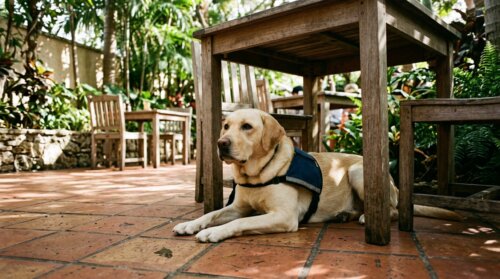
Before any task work matters, the dog must be reliably calm and unobtrusive in public: settling under a table through a whole meal, ignoring strangers who try to pet it, walking politely through a busy store, and being fully housebroken. A dog that is out of control can be lawfully excluded no matter how well it performs its tasks.
3. Task training
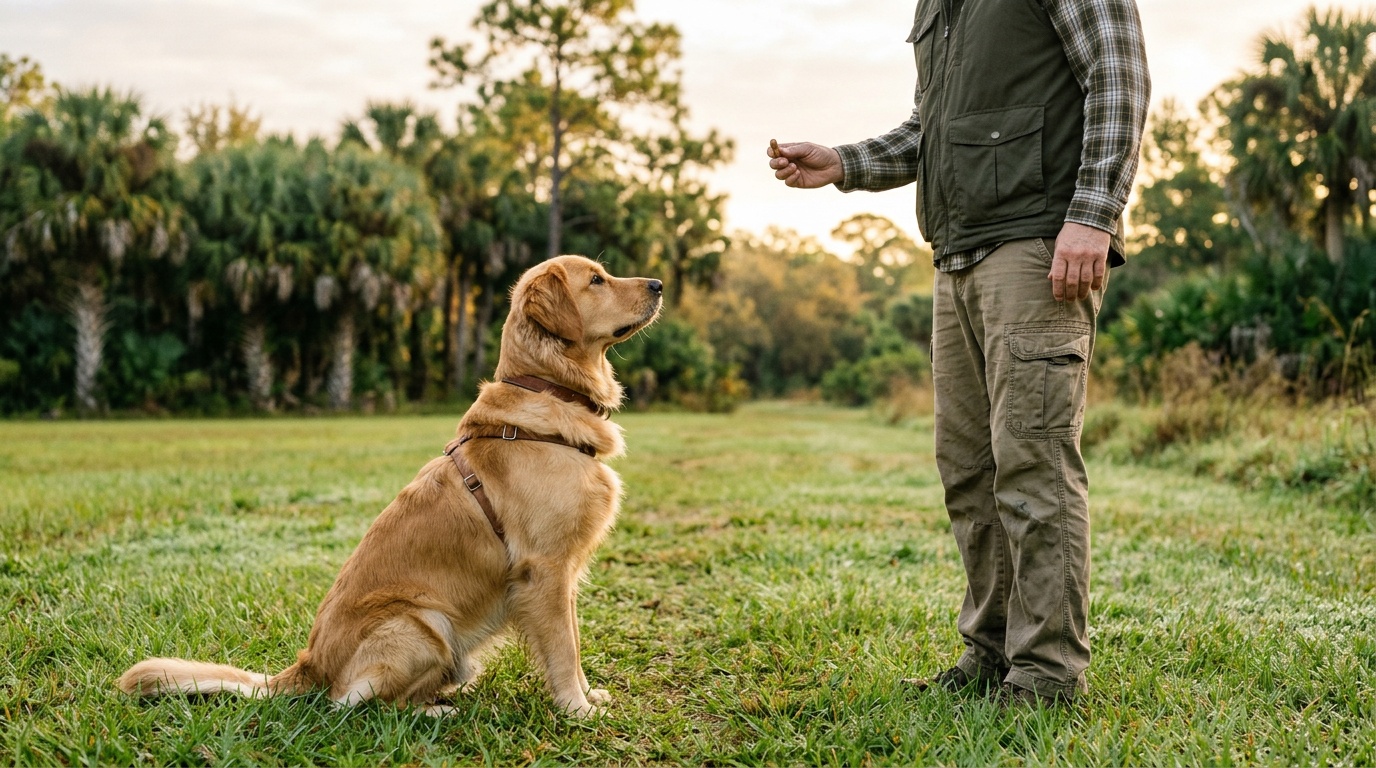
Then the actual work: teaching the specific, repeatable behaviors that mitigate your disability. This is the part that legally makes the dog a service dog.
Realistically, expect 18 months to two years of consistent work. Most successful owner-trainers hire a professional trainer for at least part of it.
Trainers in the Tampa Bay Area
You do not have to do this alone, and a trainer who has taken dogs through public access work before is worth the money. Some options on the fechPup map:
- 🎓 Courteous Canine, Inc.: Lutz, a long-established training facility north of Tampa
- 🐕 Sit Means Sit Dog Training Tampa: Fisher Avenue, east Tampa
- 🦮 Florida K9 Center: Tarpon Springs Road, Odessa
- 🏅 All Dogs Unleashed Dog Training Tampa: Stone Run Court, northwest Tampa
When you call, ask directly whether they have trained service dogs before, and what their approach to public access work is. General obedience training and service dog training are not the same discipline, and a good trainer will tell you plainly if it is outside their scope. You can browse more options on the Pet Services map.
If a website offers to “register” or “certify” your service dog for a fee, walk away. Florida requires no such thing, and no business may demand it. These sites sell reassurance, not rights.
Be equally careful with anyone promising a fully trained service dog for a few thousand dollars on a short timeline. Legitimate task training takes years, and the market has real fraud in it.
Getting a Service Dog for Free in Florida
It is genuinely possible, and the program route is how. Nonprofit organizations, including Florida-based ones, place dogs with recipients at no cost, funded by donation. There are also programs specifically for veterans, and some that focus on children.
The trade is time, not money. Free almost always means a multi-year wait, plus travel to attend team training. If you need something sooner, owner-training with paid professional help is usually the faster route, and it will cost you.
What to Do While You Wait
If you are on a program waitlist, the months are not wasted. Get your medical documentation organized and current. Learn what handling a working dog in public actually involves. If you already have a dog, invest in solid obedience work regardless of the outcome.
And sort out the ordinary logistics before the dog arrives: a Florida rabies certificate and county license will be required from day one, and our guide to Florida dog license and rabies rules covers exactly what your county wants.
How to Get a Service Dog in Florida: Common Questions
How do I get a service dog in Florida for free?
Apply to a nonprofit service dog program. Several, including Florida-based organizations, provide dogs at no cost to the recipient because the cost is covered by donors. Expect an application process with medical documentation and a waitlist that commonly runs one to three years.
Can I make my own dog a service dog in Florida?
Yes. Florida allows owner-training, and no certification is required. The dog must genuinely be trained to perform tasks related to your disability and must be reliably under control and housebroken in public. Most people who succeed at this work with a professional trainer for at least part of the process.
Is there a service dog license in Florida?
No. There is no service dog license, registry or official certificate in Florida, and no business may require one. Your dog will still need the ordinary county dog license and rabies vaccination that every dog in Florida needs.
How long does it take to train a service dog?
Programs typically raise and train a dog for around two years before placement. Owner-training runs on a similar timeline: 18 months to two years of consistent work covering public access behavior and specific tasks.
What breeds make good service dogs?
Labrador retrievers, golden retrievers and standard poodles dominate for good reason: size, biddability and temperament. Breed matters far less than the individual dog, though. Temperament assessment is what actually predicts success.
Can a service dog in training go into public places in Florida?
Access for dogs still in training is narrower than for fully trained service animals and businesses have more discretion. Many establishments cooperate willingly when asked, and professional trainers usually have relationships with local businesses for exactly this purpose. Ask first rather than assuming.