
Florida service dog laws are more generous than most handlers realize and more limited than most businesses assume. The governing statute is section 413.08, Florida Statutes, and it tracks the federal Americans with Disabilities Act closely. Once you know what it says, almost every awkward doorway conversation resolves itself in about fifteen seconds.
This guide covers what qualifies as a service animal, what a business may legally ask, what it may not, and where the rights stop.
- 🐕 A service animal is trained to do work or perform tasks related to a person’s disability.
- ❓ A business may ask two questions only.
- 📄 No documentation, registration or certification can be required.
- 💸 No deposit or surcharge may be imposed.
- 🦮 The handler must keep the animal under control, and is liable for any damage it causes.
- ⚖️ Faking one is a second-degree misdemeanor.
What Qualifies as a Service Animal in Florida
Under section 413.08(1)(d), a service animal is an animal trained to do work or perform tasks for an individual with a disability, where those tasks are directly related to the individual’s disability. For public accommodation purposes the statute limits this to dogs and, in the federal framework, miniature horses.
The word doing the work in that definition is tasks. Guiding a person who is blind, alerting to a sound, retrieving dropped items, interrupting a panic attack with trained physical contact, alerting to a blood sugar change, bracing for balance. These are tasks. Comfort provided simply by the animal being present is not a task, which is the exact line that separates a service dog from an emotional support animal.
The Only Two Questions a Business May Ask
This is the part of Florida service dog laws worth memorizing, on both sides of the counter. Under section 413.08(3)(b), staff at a public accommodation may ask:
- Is the animal a service animal required because of a disability?
- What work or tasks has the animal been trained to perform?
That is the complete list. The statute expressly prohibits asking about the nature or extent of the person’s disability, and it states that documentation that the service animal is trained is not a precondition for providing service.
What a Business May Not Do
- 🚫 Ask what your disability is, or how severe it is
- 🚫 Demand paperwork, an ID card, a certificate or a registration
- 🚫 Require the dog to demonstrate its task
- 🚫 Require the dog to wear a vest, patch or harness identifying it
- 🚫 Charge a deposit or surcharge as a condition of admitting the animal
- 🚫 Isolate you, or treat you less favorably than other patrons
On fees specifically, section 413.08(3)(c) is unambiguous: a public accommodation may not impose a deposit or surcharge on an individual with a disability as a precondition to permitting a service animal. If a hotel charges a pet fee for other guests’ dogs, it may not charge that fee for your service dog.
What the Handler Is Responsible For
Access rights come with obligations, and they are reasonable ones.
The animal must be under your control. In practice that means harnessed, leashed or tethered, unless those devices would interfere with the animal’s work or your disability prevents their use, in which case you must control the animal by voice, signal or other effective means. The dog must also be housebroken.
Section 413.08(3)(d) makes the handler liable for damage caused by the service animal, on the same terms that anyone else would be charged for pet damage. Access is free; consequences are not.
A public accommodation can exclude a service animal that is out of control and whose handler does not take effective action to control it, or one that is not housebroken. Even then, the business must still offer the person the goods or services without the animal present.
A dog that lunges, barks persistently at other customers or is loose in the aisles is not protected by Florida service dog laws simply because it is a service dog.
There Is No Service Dog Registration in Florida
None. There is no state register, no official certificate, no legally recognized ID card. The websites selling them are selling nothing of legal value, and buying one gives you no rights you did not already have.
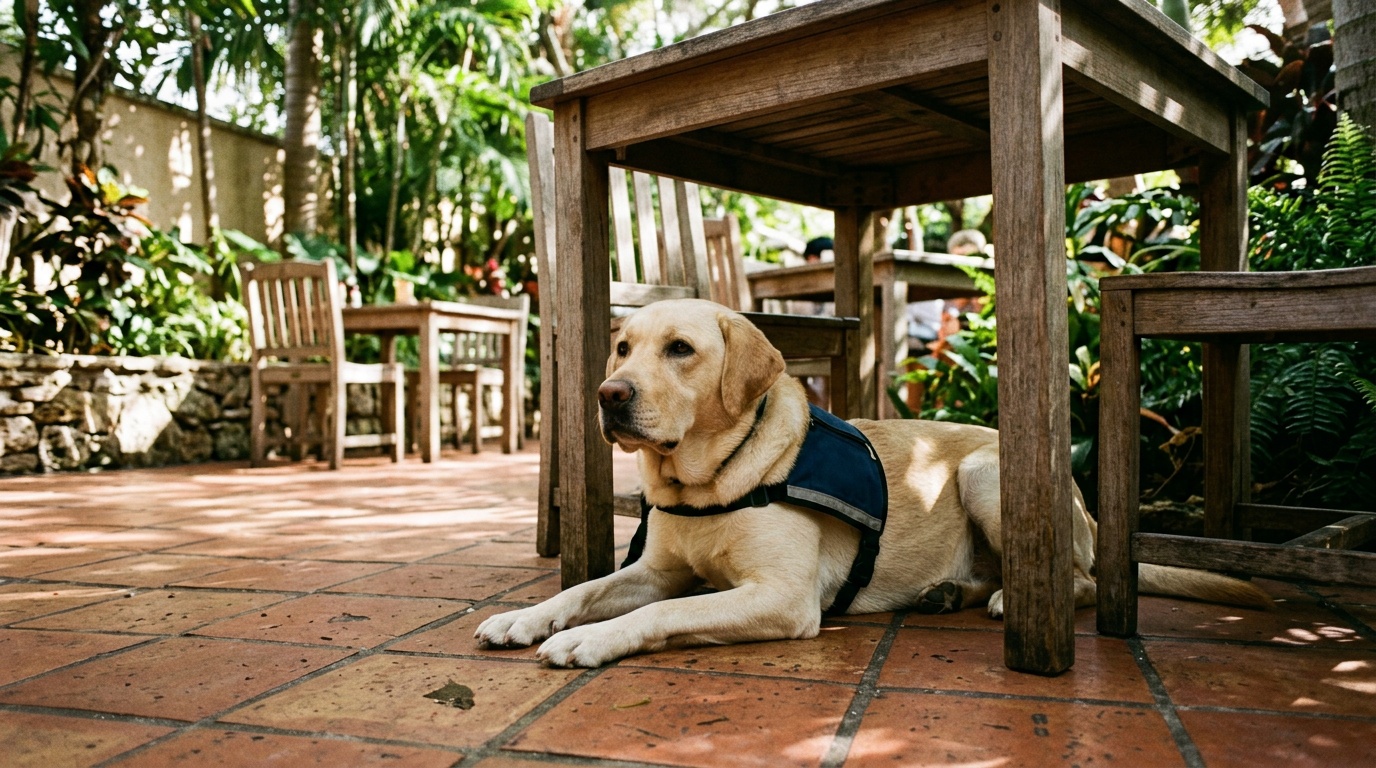
Handlers often carry a vest anyway, and that is a perfectly sensible practical choice. It cuts down on questions and signals to strangers not to distract the dog. Just be clear that it is a convenience, not a credential, and no business can require it.
Section 413.08(9) makes it a misdemeanor of the second degree to knowingly and willfully misrepresent yourself as qualified to use a service animal. A conviction also carries 30 hours of community service for an organization serving individuals with disabilities.
Florida took this seriously for a reason: every fake service dog that misbehaves in public makes life harder for the handlers who depend on real ones.
Service Animals Versus Emotional Support Animals
They are governed by different statutes and they get different rights, so it is worth being precise.
- 🐕🦺 Service animal: trained to perform tasks. Public access rights under section 413.08. Protected in housing too.
- 🏠 Emotional support animal: no training required. No public access rights. Protected in housing under section 760.27.
An ESA may be refused at a restaurant, a store or a museum entirely lawfully. If your question is really about housing rather than access, our guide to Florida emotional support animal laws covers that instead. And if you are working out how to obtain a trained service dog, see how to get a service dog in Florida.
Restaurants, Hotels and Public Accommodations
A service dog goes where the public goes. Inside the dining room, not just the patio. Into the hotel lobby, the elevator and the room. Into the shop, the bank and the theater.
This is a genuinely important distinction in Florida, because so much dog-friendly dining here is patio-only under the local outdoor dining permit programs. A pet dog is limited to the patio. A service dog is not.
Some Florida places make it easy either way. Yellow Dog Eats in Windermere built its whole identity around dogs. Irish 31 Pub House & Eatery on Swann Avenue in Tampa and Cava in Brandon both welcome dogs outdoors. On the hotel side, The Barrymore Hotel Tampa Riverwalk and The Westin Tampa Waterside both accommodate dogs.
For more, browse dog-friendly restaurants in St. Petersburg, Brandon, or the full Food & Drink map.
When staff push back, the fastest route through is usually to answer the two lawful questions before they are asked: “She’s a service dog, she alerts me to low blood sugar.” That gives them everything they are entitled to know and nothing they are not, and it ends most conversations on the spot.
Florida Service Dog Laws: Frequently Asked Questions
What disabilities qualify for a service dog in Florida?
Florida law does not publish a list of qualifying conditions. What matters is that you have a disability and that the dog is trained to perform tasks directly related to it. That covers physical, sensory, psychiatric, intellectual and other disabilities, so long as the task connection is real.
Are service dogs allowed on Florida beaches?
Service animals accompany their handlers where the public is allowed, including beaches that are open to the public. Note that this is a separate question from whether pet dogs are allowed. Most Florida beaches ban pet dogs entirely, and the three off-leash dog-friendly beaches in Tampa Bay are designated exceptions for pets, not the rule.
Can a landlord refuse a service dog in Florida?
Housing is governed by fair housing rules rather than the public accommodation statute, and a housing provider must make a reasonable accommodation for a service animal without charging pet fees or deposits. Breed and weight restrictions in a lease do not automatically override that.
Does my service dog need to wear a vest in Florida?
No. No business may require a vest, patch, harness or ID as a condition of entry. Many handlers use one voluntarily because it reduces interruptions, but it carries no legal weight.
Can a business ask for proof my dog is trained?
No. Section 413.08 states that documentation of training is not a precondition for providing service. They may ask what work or tasks the dog performs, and your answer is the only evidence required.
What do I do if I am refused entry with my service dog?
Ask calmly for a manager and state the two questions the law allows them to ask. If you are still refused, note the date, time, location and the names of the staff involved. You can file a complaint with the US Department of Justice under the ADA, or with the Florida Commission on Human Relations.
This article summarizes section 413.08, Florida Statutes, as published by the Florida Legislature, together with the federal ADA framework it mirrors. It is general information rather than legal advice. For a specific dispute, speak to a Florida attorney or a disability rights organization.